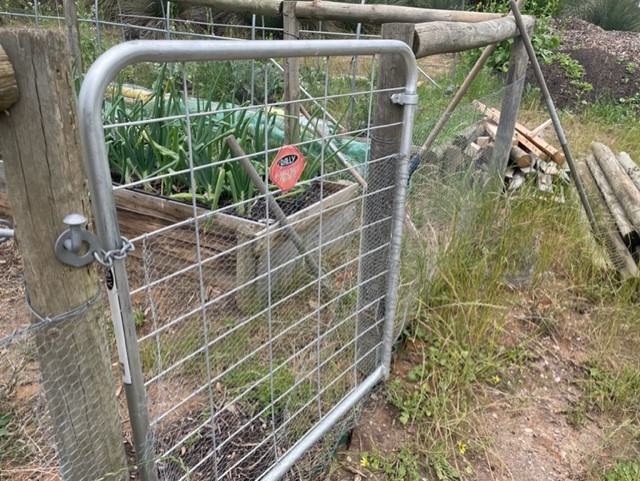
When we decided we needed to protect our food growing space from local species such as Native Bush Rats and the introduced rabbits which are a major pest in Australia, I set the challenge to do as much of it as possible from recycled and upcycled items.
The first thing we needed was a secure fence to keep out the critters that wanted to get to our food first. We live and garden right next to a patch of remnant native vegetation which is wonderful for the local species, but not so wonderful for our food gardening efforts.
We sourced second hand vineyard posts made out of treated pine. They begin life at around 2400mm long but by the time they have been in the vineyards and then chopped off at ground level to remove them they are only around 1800mm long.

Our fence didn’t need to be too high – 1200 – 1500mm high is plenty high enough to keep out most pests (and the dogs). By digging them into the ground 300mm we still have a 1200mm high fence (and because it doesn’t need to be very high we were not fussy about how exactly high it ended up).
Design for the materials you have
One of the things to remember when using recycled products is that you often need to be flexible with your design, to maximise the use of the materials you can find, rather than designing first and hoping to find just the right thing. So our fence ended up being ¾ of the length of the available posts in height.
We also wanted to be able to keep the rabbits and other critters from digging under the fence, so we used some second-hand corrugated iron that we already had to dig in a barrier below the wire fencing sections to stop anything from being able to dig under the fence.
A simple post and rail fence, infilled with small opening chicken wire has now been constructed and so far, so good. We did need to purchase new wire and while that seemed like a bit of an investment at the time, new wire is worth the investment as it will last a long time.
A word about wire
Old wire can sometimes be picked up cheaply or for free from online marketplaces but it is rare to fine a batch that is everything you need or that will be the right gauge or length. We have picked up part rolls of ring lock fencing wire in the past which has been used for small paddock projects or patching fences. Old wire can have holes in it and can end up being more work than it is worth. Buy the best wire you can afford and you will only have to put it up once – you will be glad you did.
The next piece of the puzzle is the raised beds. Utilising the old treated vineyard posts and heat treated pallets we have designed beds that place the chemically treated posts on the outside of the beds so that the residual chemicals cannot leach into the soil. And we have searched for only heat-treated pallets as they have not been chemically treated. These are used to construct the sides of the beds.

Where to find free pallets
Some great places to find free pallets are: tile shops, hardware shops, paint shops, plumbing equipment outlets. Make sure you ask the business owner first before you help yourself – some businesses will be delighted that you can take them off their hands and get them out of their yards. Others may have an agreement with their suppliers to return them.
Look for those with the HT symbol stamped on them – this means they are heat treated, not chemically treated.
Avoid painted pallets – these are just an environmental nightmare and you don’t want the pain flaking off and into your food growing soil, or flaking off and into the big wide world either – avoid these at all costs.
Soil
The beds we have finished so far have been filled with commercially produced organic soil which has already been used to grow our microgreen crops (which we sell at the local farmers’ market), and then composted. When it has sat in our compost bays for around 6 months and the original remnant plant matter has broken down, we shovel what is left of the soil/compost into these raised garden beds.
If you don’t have access to pre-loved soil, you can make your own compost from kitchen waste, garden cuttings, animal manure, rock minerals and dry leaves – it will take some time – most things that are worthwhile do!
Start composting before you start building your garden area so that you have good quality compost to use when the beds are built.
And then we plant our crops into them. When they are finished, they look like this.
We have also created a raised bed out of corrugated iron and vineyard posts – we did this one quickly as we wanted to get our potatoes in before the weather got too warm. This is a temporary bed, will probably have only 2 or 3 crops in it over its life time before it gets replaced with the compost bins that are planned for that corner of the fenced garden.

What’s next
Our next project in the fenced veggie garden will be to construct a worm farm and we have an old recycled bath ear-marked for just this purpose. It will be raised up on a wooden frame, constructed from second hand and left-over timbers which we get from a local business. Raising the bed up allows us to angle it slightly downwards towards the plug hole. We can then place a bucket under the plug hole and catch the worm juice for adding to our garden.
Along the external west side of the garden, we plan to plant a hedge of native rosemary to attract the beneficial insects and shield the garden from the hot afternoon sun and strong summer winds. On the south side we are constructing a hoop house/poly tunnel to extend our growing season and provide protection to the garden from the cold winter winds.
It’s a project that we are working on gradually in-between the demands of life, but it is so rewarding and in the next few weeks I will harvest my winter garlic and onions. I’ve already got my summer pumpkins, zucchini, beans, corn and cucumbers planted in the second bed and they are coming along.
When the garlic and onions come out, I will plant out tomatoes, basil and lettuce into that bed. By then the third raised bed will be just about ready for planting and the potatoes should be ready to harvest so I will have some space for a late summer crop of something – off to read the seed catalogues …